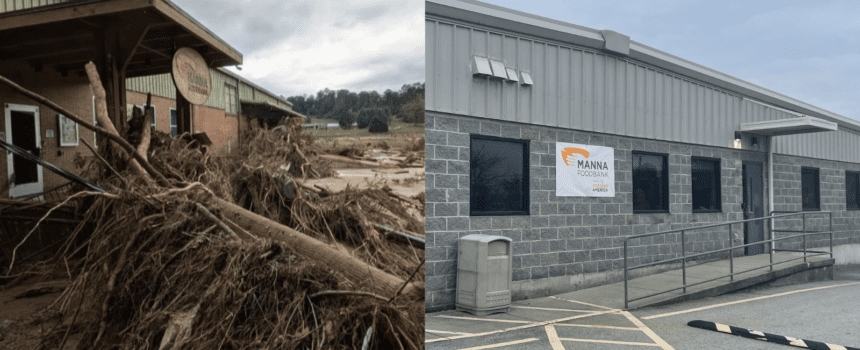
 Food banks in southern America are currently facing major damage due to Hurricane Helene. This natural disaster caused road closures, power outages & destroyed facilities and homes across the impacted areas.
Alongside the 100,000+ pounds of food we’ve sent down south (including prepacked boxes for Second Harvest Food Bank of Northeast Tennessee and non-perishables for Feeding Tampa Bay), one of our employees, Kara, volunteered to visit Asheville to directly support the MANNA FoodBank.
The daily updates below showcase the impact she’s helping to make during her time in North Carolina.
Day 1
I’m staying at a hotel about seven minutes from the MANNA FoodBank, so it was a quick drive. However, the remnants of Hurricane Helene are still evident. At this point, we’re a few weeks out from when the hurricane hit, so there has been some time to clean up, but many houses and buildings still have downed trees in front of them. Most of the trees have been gathered into piles in front yards, cut into smaller pieces, but not always. One of the MANNA staff members I’m working alongside said that a group of men with no affiliation came to her door asking if she needed help with any of the trees in her yard. They cut them up with their chainsaws and then went on to the next house on the block. This doesn’t surprise me, as the community support has been notable even within the small radius that I’ve traveled. There are plenty of homemade signs on street corners and in front of houses that say, “Food this way” or “Need help? Call xxx-xxx-xxxx.”
I think sometimes the worst situations can bring out the best in people, and I’m definitely seeing that here even weeks after the hurricane.
MANNA was in the process of looking into different facilities, as they had already considered moving their food bank location due to its proximity to the river and the constant risk of flooding. Their plan was to talk to some companies about the cost of renovations at a few different prospective locations, with the aim of moving into a new and renovated facility in the summer of 2026. However, what happened instead was that a storm hit on a Thursday/Friday, and they signed a lease and moved into a new place that Monday. Needless to say, they were not prepared. The new building is 30 to 40 minutes away from their previous location, so staff members who previously had a 20-minute commute now face commutes of over an hour. Most people have been carpooling together. The building was formerly a FedEx facility, so the warehouse is massive and has plenty of loading and receiving docks on both sides. Currently, they do not have any coolers or freezers, and they are working on getting some racking into the warehouse. As a result, they can only take and distribute shelf-stable foods for now.
The part of town that I’m in wasn’t too severely impacted, but the MANNA Food Bank’s previous facility was destroyed. They shared photos with me today that brought us all to tears, including their colorfully decorated ‘Partner Agency Corner’ sign, which was about 5 feet off the ground and covered in mud because that’s how high the flooding was. Two of the MANNA staff members had their homes completely taken from them by the hurricane.
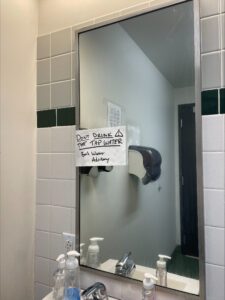
For the most part, western North Carolina does have running water, but it is not drinkable. They recommend boiling the water before drinking it or opting for bottled water instead. There’s no shortage of bottled water at the facility, and the MANNA staff shared that while they still have a lot of cases of water, a large portion of what they had went to nearby schools because those schools didn’t have drinking water, which was keeping many districts from being able to return to school. Most schools in the area were only closed for one week, but for some places that were most severely impacted, it was two or three weeks.

Day 2
Not being able to drink water from fountains or sinks is a problem that likely won’t go away soon. Just as an individual, I’m going through about six water bottles a day between drinking, brushing my teeth, and using them while cooking, etc. As this is the case in most places in the area, the recycling bins have been filling up pretty quickly. You can learn more about Asheville’s potable water status here.
Wednesdays are Tie Dye Wednesdays, and tomorrow is Halloween. Despite the chaos, the traditions remain, and many staff members wore some form of tie-dye clothing, with most planning to dress up for Halloween! I was invited to join in on a group costume.
Today, some new forklifts arrived, which was very exciting and will be helpful to the food bank. A lot of machinery was lost in the flood, so they’ve been renting and purchasing new equipment, but it takes time for everything to come in.

Their immediate expenses are much higher than they could have ever predicted. They’ll be officially purchasing this facility soon, along with new racking, renovations, adding a freezer and refrigerator, and a million other things.
MANNA has an Empty Bowls event that was supposed to take place in the second week of October, but it was unfortunately canceled this year. I’m meeting with the staff member who spearheads their Empty Bowls program this Friday, so I’m looking forward to bouncing ideas off each other and hearing how they responded to the cancellation. I’ll learn more in our meeting, but I was told that out of the hundreds of people who bought tickets, only three requested refunds after the cancellation email was sent.

Day 4 & 5
After primarily handling administrative work for their development team, I had the opportunity to sit in on one of their weekly team meetings and contribute.
During the meeting, one staff member said, “We can’t rely on the community that was also hit by a hurricane to help us bounce back from the same hurricane,” and it really struck me.
MANNA has officially received donations from all 50 states and many countries, which is both special and crucial to their recovery. Nearly everyone here has been directly affected by the hurricane in some way, so bouncing back will undoubtedly require sustained support from individuals, companies, and foundations from across the country.
They are still in the process of installing sprinkler systems in the warehouse, so until those are completed, they can’t add racking or refrigeration/freezers. In the meantime, they are operating 8 refrigerator/freezer trucks 24/7 to distribute meats and produce. While they aren’t able to distribute the volume they normally would, they will get there once a more permanent solution is in place.
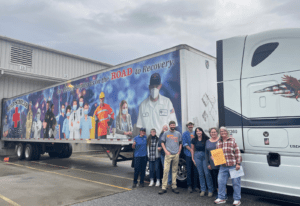

Additionally, a truck from the greater Scranton, PA area delivered hundreds of cases of water to MANNA, along with handwritten notes from the town’s elementary school. The students wrote messages of encouragement and hope, which were hung on the walls of the MANNA facility for staff to see as they enter.

Day 6 & 7
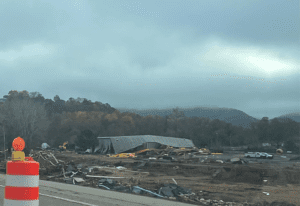
After spending a week at MANNA Food Bank, I was able to take the weekend off and visit some of my family in Tennessee, about 1.5 hours away. On my drive through Tennessee, I passed through the city of Erwin, and it was heart-wrenching. The two- and three-lane highways were reduced to one lane due to the devastation. While people were able to get through, it was impossible not to see the extent of the damage in this town, which runs alongside creeks and rivers, after being hit by Hurricane Helene.
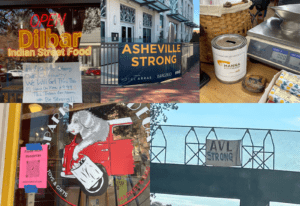
I also had the chance to visit downtown Erwin and got a fuller picture of how the community is still supporting one another in so many ways. “Leaf season” (September-November) is when Asheville’s locally owned stores typically see their highest tourism traffic. Food bankers with connections to local shops shared their concerns that the lack of tourism, caused by the hurricane, might result in some local stores closing. However, as I shopped in some of the stores, I saw that many were offering discounts to locals, sharing resources for those affected, or collecting donations for nonprofits supporting hurricane relief. Around town, there were numerous flyers with a QR code that people could scan if they were in need of assistance, and many stores had these flyers inside as well.
The Mast General Store, a popular spot for tourists, was collecting donations for MANNA in several ways: a cash donation jar, a “round-up” option at the register, and 20% of the proceeds from their graphic t-shirts were being donated to MANNA.
Week 2
This week seemed to be the first time that many staff members at MANNA were able to catch their breath since Hurricane Helene. While everyone always has a full plate of work, it felt like this week folks had the opportunity to step back from disaster mode and focus on long-term strategy, making plans to operate their new facility in a sustainable way.
The conversation about what exactly was lost in the storm has become more concrete. They’ve shared that just when they think they’ve captured everything, they remember five more things that were lost. In addition to the work-related items lost at MANNA’s old facility, most people also lost personal belongings they had at their desks, which can’t be replaced. On a positive note, some furniture was recovered from the less-affected parts of the old facility, which has helped bring the building back to life a bit.
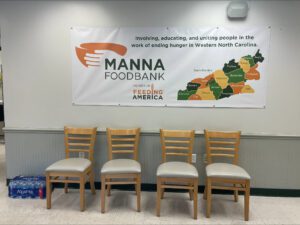
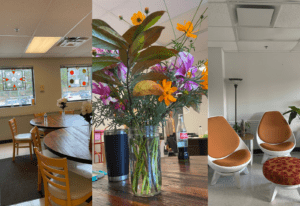
This week’s highlights included several visual upgrades. Lovely furniture was donated by local restaurants, someone added stained-glass artwork to the windows, flowers were brought in, they got a second microwave, and a functional paper towel dispenser was installed. Another morale boost has been that nearly every day I’ve been here, someone has brought in Dunkin’ Donuts or bagels for the team.
I’ve spent the week helping with data entry and database cleanup, and learning just how generous people from all around the country have been in supporting MANNA Food Bank. While this week has been challenging, the generosity I’ve witnessed—through monetary gifts and the heartfelt letters I’ve read—has been a powerful reminder that people do care for each other, and we must continue to care for one another.
Although my time here has been incredibly special, I look forward to coming home this weekend and bringing back some of the lessons I’ve learned to Greater Pittsburgh Community Food Bank. I feel confident leaving MANNA at this point. They have strong leadership to guide them through this journey, and an incredible staff who will continue their important mission of providing meals to neighbors in western North Carolina.
NOTE: These updates are written by Kara, from her point of view. We’ve made minimal edits for grammar and to protect sensitive information.